Key Projects
Automated Alignment Station: Mechanical & Optical Design
Designed the mechanical and optical hardware for an automated alignment station used in FORJFiber Optic Rotary Joint assembly, covering everything the automated search depends on physically: how the parts are held, how the optics are located, and how the motion axes and measurement instruments are arranged around them.
- Developed hard-datum stage-to-part mounting, making alignment results repeatable across runs and units
- Designed the optical bench layout and multi-axis stage stack-up, integrating the power meter directly into the measurement loop
- Enabled operator load and unload without disturbing established alignment
Tools Used:
Automated Collimator Alignment: Python Software Development
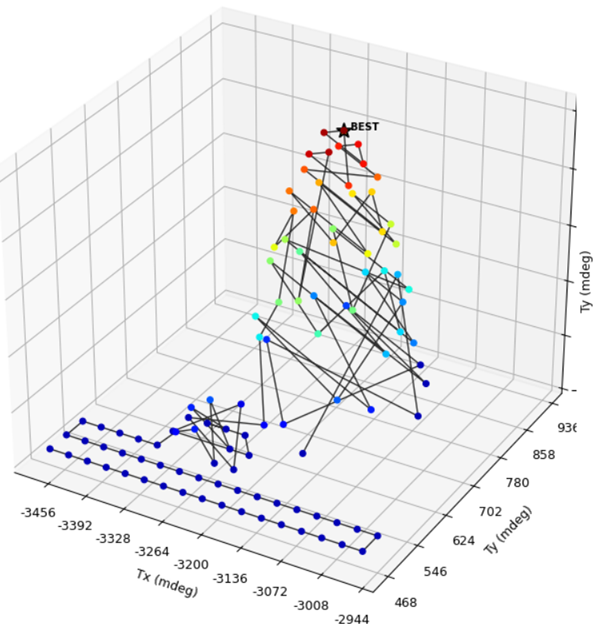
Developed a Python application that drives the alignment station's motorized stages across tilt and translation axes, closing the loop on live optical power feedback to bring a collimatorOptic that shapes light into a parallel beam so it can cross the rotating gap pair from no signal to optimized coupling with no operator input. Collimator-to-collimator alignment was previously the most experience-dependent step in assembly, performed entirely by hand.
- Developed an adaptive multi-axis search routine that locates first light, then converges on peak optical coupling across tilt and translation axes
- Designed filters to identify false peaks and stray light, preventing false positives and collimator misalignment
- Implemented 3D scan plots that map the collimator surface
- Rolled out to the assembly floor across FORJ production
Tools Used:
Optical Test Protocol & Fixturing
Established the optical test methods used to qualify finished rotary joints, along with the fixturing required to run them consistently across a product line spanning many channel counts and fiber types.
- Defined insertion lossOptical power lost through a connection, measured in dB and rotational variationChange in optical loss as the joint rotates test methods with explicit pass/fail criteria
- Designed dedicated test fixturing to hold units repeatably through full rotation
- Extended the test method across single-mode and multimode builds spanning the full channel-count range